[in progress! while I work on this article, here’s a fantastic one from Frontier Alliance International:]
2022 Dates: 10/04/2022 – 10/05/2022 (Sunset to Sunset)
Jewish Calendar Date: 10 Tishri
Source: https://www.hebcal.com/holidays/
[ Jonah, Justice, and Mercy that Covers | FAI Publishing ]
Yom Kippur, the Day of Atonement, is considered the holiest day in the Jewish biblical calendar. It is 10 days after Feast of Trumpets. Unlike the feast of trumpets, this day is not a feast, it’s a fast. It is a day of no eating or drinking, and a day of humbling oneself before the Lord. In fact, the original commandment to Israel was that whoever does not fast during that day, will be “cut off from his people” (see: karath). The same punishment goes for anyone that does not observe this day as a Sabbath, a day of rest, and works on that day. This means death! (also see Leviticus 16:29, Numbers 29:7).
Why such a severe consequence for not observing this day as commanded? There certainly seems to be a lot of death in scripture. How should Christians view death? How should Christians view the Day of Atonement? What is its significance? These are the questions I want to explore.
26 And the Lord spoke to Moses, saying, 27 “Now on the tenth day of this seventh month is the Day of Atonement. It shall be for you a time of holy convocation, and you shall afflict yourselves and present a food offering to the Lord. 28 And you shall not do any work on that very day, for it is a Day of Atonement, to make atonement for you before the Lord your God. 29 For whoever is not afflicted on that very day shall be cut off from his people. 30 And whoever does any work on that very day, that person I will destroy from among his people. 31 You shall not do any work. It is a statute forever throughout your generations in all your dwelling places. 32 It shall be to you a Sabbath of solemn rest, and you shall afflict yourselves. On the ninth day of the month beginning at evening, from evening to evening shall you keep your Sabbath.”
Leviticus 23:26-32 ESV
Leviticus 16 Instructions
- In Leviticus 16, we find out about what the role of the High Priest is during the Day of Atonement.
- this takes place on the 10th day on the 7th month of the Hebrew calendar.
- It is to be a Sabbath (day of rest) and the people are to “deny/afflict themselves”
- a day to set aside things you normally would partake in as a form of fasting something other than food
- Aaron (the high priest at the time) enters the Holy Place with a young bull as a sin offering, and a ram as a burnt offering.
- the bull is a sin offering for himself and provides atonement for himself as well as his household.
- High priest is to wear holy garments made of linen which consist of a tunic, shorts, a sash and a turban.
- he is to put these on after bathing
- For the community, he is to bring 2 goats as sin offerings and a ram as a burnt offering.
- these goats are to be brought to the entrance to the tent of meeting (tabernacle/temple).
- lots are to be cast to determine which goat is to be for God as a burnt offering and which is to be the scapegoat or Az’azel.
- before entering the curtain, Aaron is to take a censer full of burning coals and with his hands full of fragrant incense, enter into the curtain. The smoke from the incense will cover the ark so the high priest (in this case Aaron) will not die.
- The high priest is to sprinkle the bull’s blood on the ark cover, towards the east, and in front of the ark-cover 7 times.
- then the high priest will slaughter the goat of the sin offering and sprinkle the blood in the same manner as the bull’s blood.
- this is to make atonement for the Holy Place because of the uncleanness of the people of Israel.
- the high priest is to do make atonement for the tent of meeting with the blood as well due to their uncleanness.
- NO ONE is to be present when the high priest is doing this. They are not to come into the tabernacle/temple until he’s done.
- then the high priest will go out to the altar and make atonement for it by sprinkling some of the bull’s blood and some of the goat’s blood and put it on all the horns of the altar. He will also sprinkle it 7 times– thus purifying it and making it holy from the uncleanness of the people of Israel.
- The high priest will be atoning for himself, his household and for the entire community of Israel
- the high priest atones for the Holy Place, the tent of meeting and the altar.
- Then the high priest presents the live goat. He lays both hands on the head of the live goat and confess over it all the transgressions, crimes and sins of the people of Israel; putting them on the head of the goat and sends it out, away into the desert with a man appointed to take it there.
- “The goat will bear all their transgressions away to some isolated place.”
- the high priest goes back inside, removes linen garments and leaves them there, bathes and puts on his other clothes.
- Then he comes back out, offers up 2 rams as burnt offerings (1 for him and 1 for Israel)
- “Make the fat of the sin go up in smoke on the altar.”
- the man who accompanied the scapegoat out into the desert is to wash his clothes and bathe his body before returning to the camp.
Leviticus 16:27-33 says what to do with the remains of the sin offerings, including for the person who dealt with the remains.
Also read: Numbers 29:7-11; Isaiah 57:14-58:14, 52:13-53:12; Romans 3:21-26; Hebrews 7-8
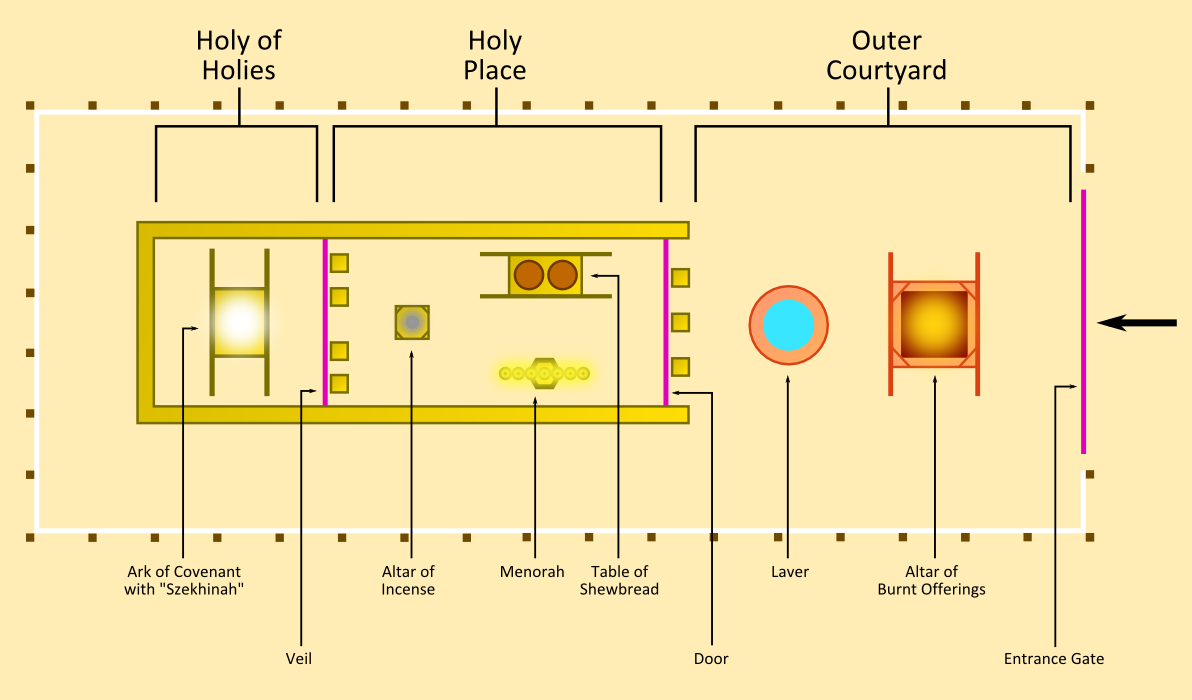
In the Mosaic Law, only the High Priest (descendant of Aaron) was allowed to enter the holiest, innermost part of the Jewish Temple, called the Holy of Holies. This is because God said He will be in there! Even then, he could only enter on one day of the year. That day was on the Day of Atonement. One cannot casually enter God’s presence. A sinful man entering God’s presence results in death (Exodus 33:20,Habakkuk 1:13).
Remember this when we look at what Jesus accomplished– resulting in the tearing of the veil that leads to the Holy of Holies (Hebrews 10:19-20).
The High Priest would enter the Holy of Holies to make atonement for the nation of Israel.
Notes from book “God’s Appointed Times”
- When the high priest would enter the Holy of Holies to make atonement for the nation
- Leviticus 16 provides details about ceremony
- one goat is a blood sacrifice
- one goat is scapegoat, called Azazel (?). The Priest lays hands on this one and confesses the sins of the people. Instead of slaying it, it is released in the wilderness, symbolically taking the sins away from their midst.
- fast on Day of Atonement (Isaiah 58:5)
- Zechariah 8:19 – fast days will become joyful and glad occasions (these are the days of Messiah!)
- customary to have a holiday meal before sundown leading up to Yom Kippur.
- table set with best linens and dishes, white can be used since it symbolizes the hope of the “high holy days, the cleansing from our sins, Isaiah 1:18)
- 2 candles lit and blessings said over the wine and the Challah bread
- Romans 3:23-26 points to Day of Atonement
- “propitiation” word in this passage, in its Hebrew equivalent, is atonement.
- In Luke 4:16-22 Jesus reads Isaiah 61
- in doing so he claims to be the Messiah, who would set the captives free
- some rabbis believe Jesus will come on Yom Kippur in the Year of Jubilee (Leviticus 25:10).
- Zechariah spoke of a future day of repentance when God will pour out his spirit in the latter days and they will look to the one whom they pierced (Zechariah 12:10)
- This points to Rosh Hashanah
- Zechariah 13:1 points to Yom Kippur
- Romans 1:25-27
Other Sources:
“The Day of Atonement was the most solemn day on the Feast Calandar. It was the only day that the High Priest could enter the Holy of Holies to being the blood into the presence of God. This day is filled with warnings, which if the priest did not follow exactly, he would be struck dead. For this reason it was the only day where everyone was required to fast. Jesus’ second coming to destroy the Antichrist and his followers, and bring salvation to His elect, will be on this day.”
Other Bible Passages
Questions to consider:
- If the return of Jesus falls on the Fall holidays, could he arrive on Feast of Trumpets?
- People like Tim Warner from 4Winds Fellowships seem to think Jesus’ return would fall on the Day of Atonement (10 days after Feast of Trumpets).
- Is this when Israel as a nation finally repents before the Lord and He pours out a Spirit of grace on them? (Zechariah 12:10)
Supplemental Resources
[VIDEO] Covenant and Controversy Part II The City of the Great King
[VIDEO] One for Israel | Yom Kippur
[VIDEO] Yom Kippur | Unlearn the Lies
[VIDEO] The Day of Atonement – and what it means for us | Unlearn the Lies
[VIDEO] What is Yom Kippur? | BimBam
Months of the Jewish Year | My Jewish Learning
BimBam | Why Does the Jewish Calendar Change Every Year?